Blackpool's underlying geology presents a complex sequence of Quaternary glacial till, outwash sands, and marine alluvium that demands precise characterisation before any foundation or earthworks design. The Fylde coast deposits frequently contain laminated silty clays whose engineering behaviour shifts dramatically with seasonal moisture changes — a reality encountered in projects from the Talbot Gateway regeneration to coastal defence upgrades. Determining Atterberg limits on these materials provides the quantitative framework for predicting volume change potential, a parameter that governs everything from pavement subgrade performance to retaining wall backfill specification. When the clay fraction exceeds 25 percent, as it commonly does in the boulder clay deposits underlying areas like Marton and Bispham, the liquid and plastic limits become essential inputs for classifying the soil within the Unified Soil Classification System and assessing its suitability as engineered fill in accordance with BS 5930:2015.
A plasticity index exceeding 30 percent in Blackpool's marine alluvium signals high shrinkage-swell potential that directly impacts foundation depth calculations under BS 8004:2015.
Our approach and scope
Local geotechnical context
BS 5930:2015 and Eurocode 7 (BS EN 1997-2:2007) require that cohesive soils be classified by both grading and plasticity when the fines content exceeds 35 percent — a threshold routinely crossed in Blackpool's Quaternary deposits. The risk of omitting Atterberg limits from a ground investigation along the Fylde coast is not theoretical: foundations designed on clay classified solely by visual-manual methods can experience differential settlement when seasonal moisture fluctuations trigger shrink-swell cycles in medium-to-high plasticity soils. This mechanism has been documented in residential developments north of Blackpool where inadequate soil classification led to cracking in masonry walls within five years of construction. The plasticity index also feeds directly into liquefaction susceptibility screening for the interbedded silts found at depth near the seafront, and when combined with CPT data provides the basis for assessing cyclic softening potential under seismic loading scenarios relevant to the region's low-to-moderate seismicity.
Relevant standards
BS 1377-2:2022, BS 5930:2015+A1:2020, BS EN 1997-2:2007 (Eurocode 7)
Complementary services
Atterberg Limits Testing Suite (BS 1377-2)
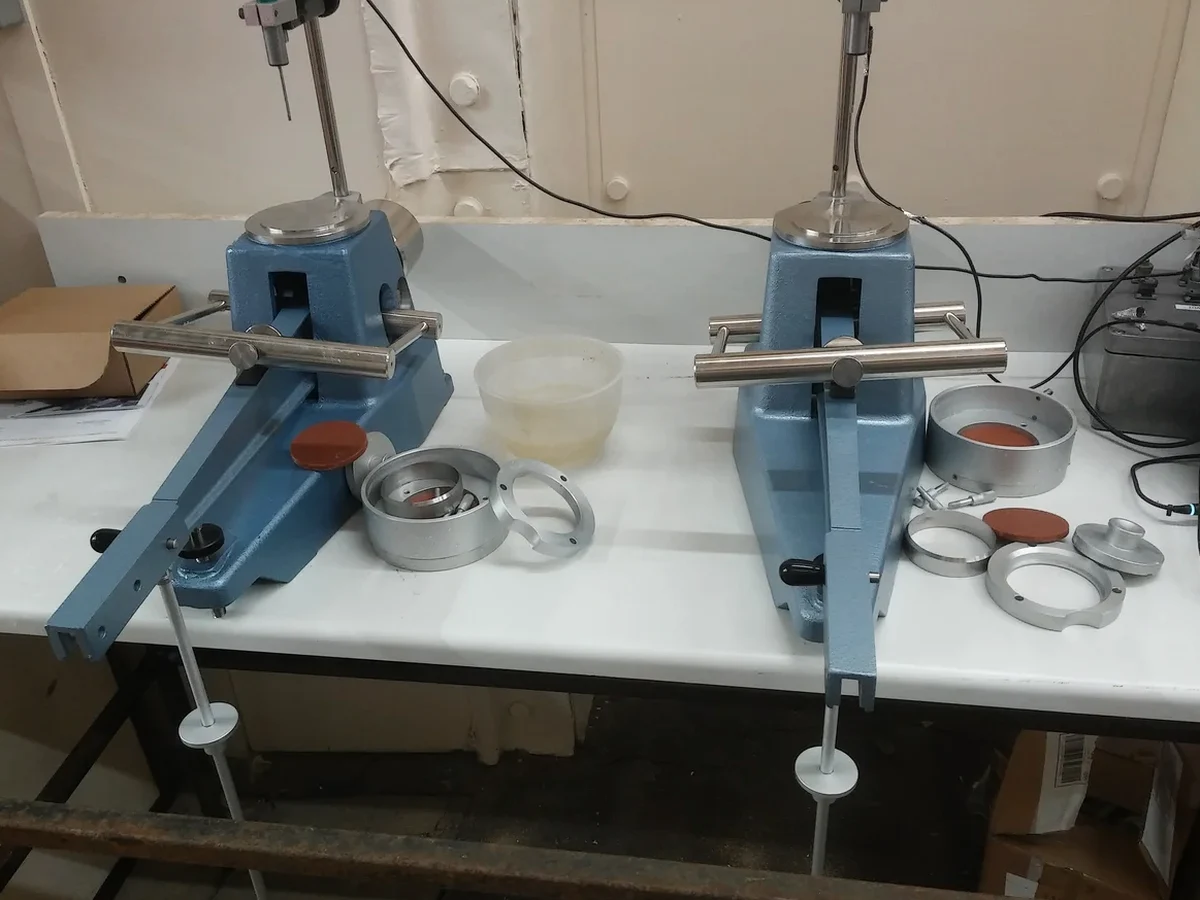
Full determination of liquid limit (cone penetrometer method), plastic limit (thread rolling), and plasticity index with classification per BS 5930 plasticity chart. Includes natural moisture content correlation and liquidity index calculation for in-situ consistency assessment. Suitable for glacial till, alluvial clay, and weathered mudstone samples from across the Blackpool area.
Combined Classification Package
Atterberg limits paired with wet sieving and hydrometer analysis to produce complete particle-size distribution curves and USCS classification. Essential for earthworks specification under Series 600 of the Specification for Highway Works when assessing acceptability of cohesive fill materials for road embankments and general fill applications.
Typical parameters
FAQ
What is the current cost for Atterberg limits testing in Blackpool?
The standard Atterberg limits test (liquid limit, plastic limit, and plasticity index on one sample) ranges from £40 to £80 depending on sample condition and whether expedited turnaround is required. Bulk pricing applies for projects submitting five or more samples, and the combined classification package including particle-size distribution is priced separately. Contact the laboratory with your sample count for a firm quotation.
How long does it take to receive Atterberg limits results for Blackpool soil samples?
Standard turnaround is five working days from sample receipt, assuming the material does not require extended air-drying due to high natural moisture content — a common situation with Blackpool's marine alluvium. Expedited three-day service is available for time-sensitive projects, and preliminary liquid limit values can often be reported within 48 hours for repeat clients with established testing protocols.
What preparation does a Blackpool site sample need before Atterberg limits testing?
Samples should be sealed in airtight containers immediately after extraction to preserve natural moisture content, as BS 1377-2 requires testing from the wet state for most applications. Disturbed bag samples of approximately 300 grams are acceptable for Atterberg limits alone, though we recommend 1 kg minimum if grain size analysis will also be performed. Avoid contamination with calcium-based drilling fluids commonly used in rotary boreholes through Blackpool's glacial till.
Why are Atterberg limits particularly important for construction projects along the Fylde coast?
The Fylde coast's Quaternary geology places highly plastic marine clays and variable glacial tills within the zone of influence for shallow foundations, and these materials exhibit significant strength reduction when wetted and substantial shrinkage during dry periods. Atterberg limits quantify this behaviour through the plasticity index and liquidity index, allowing engineers to apply appropriate foundation depth corrections and specify moisture-conditioned earthworks that meet end-product specification requirements under BS 6031 for earthworks on the coastal plain.