Too many times we see project delays in Blackpool traced back to a single oversight: treating the ground as a uniform material. The Fylde coast has a complex Quaternary geology that varies dramatically over short distances. Underneath the topsoil you might find glacial till, then layers of sand and gravel, and then stiff boulder clay before hitting the Mercia Mudstone. Specifying foundations without a proper soil mechanics study here is like navigating the Irish Sea without a depth chart. When the stratigraphy changes every few hundred metres, the in-situ permeability of the upper sands directly affects drainage design, and the undrained shear strength of the deeper clay governs bearing capacity. We run the full suite of index and strength tests to characterise each distinct layer so your design assumptions match what is actually underground.
Blackpool's ground is a layered archive of glacial advance and retreat. Reading it correctly separates a trouble-free foundation from a decade of structural distress.
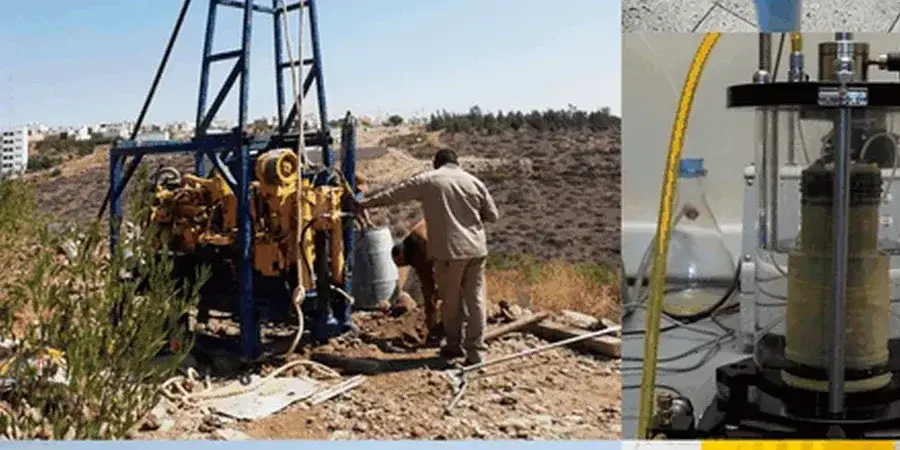
Our approach and scope
Local geotechnical context
The Mercia Mudstone Group underlies much of Blackpool at depth, and it presents a specific risk that inexperienced contractors overlook. When this overconsolidated clay is unloaded by excavation, it can swell over weeks or months, lifting lightly-loaded slabs and damaging service trenches. The water table across the Fylde coast sits high, often within two metres of ground level, which means any basement or deep excavation requires continuous dewatering. Combine a high groundwater level with loose granular layers, and you have conditions that can trigger running sand into excavations if the hydraulic gradient is not managed. A soil mechanics study quantifies the swell pressure of the Mudstone and the critical hydraulic gradient for the sand layers so the contractor can plan dewatering and heave protection before moving a single cubic metre of earth.
Relevant standards
BS 5930:2015+A1:2020 – Code of practice for ground investigations, BS EN 1997-1:2004 – Eurocode 7: Geotechnical design – General rules, BS EN ISO 17892 – Geotechnical investigation and testing – Laboratory testing of soil, BS 1377 – Methods of test for soils for civil engineering purposes
Complementary services
Index property testing
Moisture content, Atterberg limits, particle size distribution by wet and dry sieving, and specific gravity. These define the soil class and flag potential problems like high plasticity or gap-graded material.
Strength and compressibility
Unconsolidated undrained (UU) and consolidated drained (CD) triaxial tests, oedometer consolidation tests, and laboratory vane shear. We provide the effective stress parameters your designer needs for slope stability and settlement analysis.
Chemical and durability analysis
pH, sulphate content, chloride levels, and organic matter content. Critical for specifying buried concrete class in Blackpool's aggressive coastal groundwater environment.
Typical parameters
FAQ
How deep should a soil mechanics investigation go for a typical Blackpool residential extension?
For a single-storey extension, boreholes or trial pits should reach at least 3 metres below proposed foundation level, or into competent natural material. In Blackpool, this often means penetrating the made ground and at least 1.5 metres into the underlying glacial till. The exact depth is governed by the zone of influence of the foundation load, which we calculate using the 2:1 stress distribution method per BS 8004.
What is the approximate cost range for a soil mechanics study on a small commercial plot in Blackpool?
For a small commercial plot with two to three boreholes and a standard laboratory testing schedule, the soil mechanics study typically falls in the range of £2,700 to £4,060. The final figure depends on access conditions, depth of investigation, and the number of strength tests required. We provide a fixed-price proposal after reviewing the site plan and the proposed development.
Do you test for sulphate attack potential in Blackpool soils?
Yes, we routinely test for water-soluble and acid-soluble sulphate, along with pH and magnesium content, because the Mercia Mudstone and overlying drift deposits in the Blackpool area can contain gypsum and pyrite oxidation products. The results feed directly into the BRE Special Digest 1 concrete design classification so your structural engineer specifies the correct Design Chemical Class for buried concrete.
How long does the laboratory testing phase take for a standard soil mechanics study?
Index tests such as moisture content and particle size distribution are completed within three to five working days of sample receipt. Strength tests, particularly consolidated triaxial and oedometer consolidation, require longer because of the saturation and consolidation stages; these typically report within ten to fifteen working days. We schedule testing to coincide with the site works so the factual and interpretive reports are ready when the contractor needs them.