Blackpool’s coastal geology presents a specific set of challenges that only become apparent once you open the ground. The superficial deposits shift dramatically within a few hundred metres—from loose, wind-blown sand along the Promenade to stiff glacial till further inland near the M55 corridor. We have seen schemes where a standard cantilever design was proposed without accounting for the high water table at 1.2 metres below ground level, which is common in the South Shore area. The design process here requires more than a textbook solution: it demands a granular appreciation of how tidal fluctuations affect pore water pressure behind the wall face. A properly executed retaining wall design in this environment must integrate groundwater control measures from the very first stability calculation, referencing the partial factors set out in Eurocode 7 and the ground investigation protocols of BS 5930:2015+A1:2020.
A retaining wall on the Fylde Coast is a hydraulic structure first and a structural element second; drainage design dictates the factor of safety more than the reinforcement schedule.
Our approach and scope
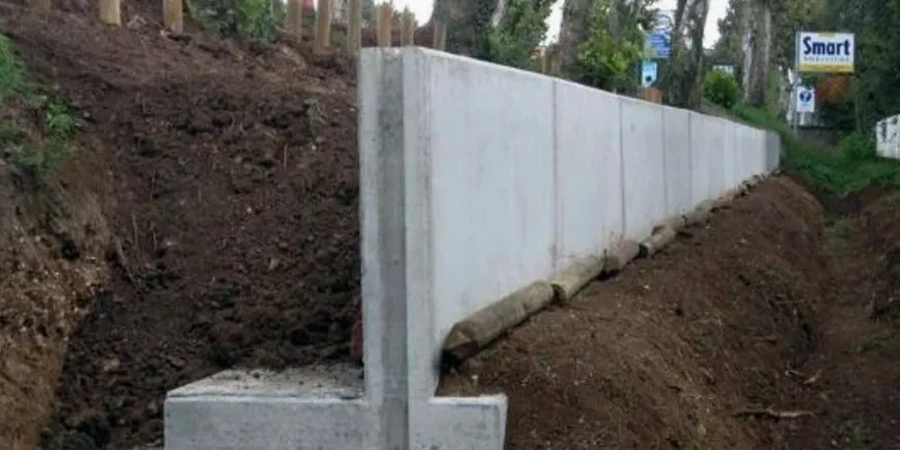
Local geotechnical context
The contrast between North Shore and the area around Blackpool Airport illustrates how much the ground can vary. North Shore sits on a thick sequence of medium-dense sand with gravel lenses, which offers decent bearing capacity but drains so freely that internal erosion becomes the dominant failure mode. Around the airport, the superficial cover is thinner and the underlying Mercia Mudstone Group appears at shallow depth, introducing a completely different risk profile: the claystone weathers rapidly on exposure, losing strength and requiring immediate blinding concrete after excavation. The most serious consequence we have documented involves a service yard retaining wall where the design assumed drained conditions year-round, but a blocked street drain during a winter storm created an undrained loading scenario that exceeded the wall's structural capacity. Water management is never an afterthought here; it is the primary design constraint. In both settings, a complementary in-situ permeability test provides the hydraulic conductivity value needed to calibrate the drainage design and avoid these failures.
Relevant standards
BS EN 1997-1:2004 Eurocode 7: Geotechnical design – General rules, BS 5930:2015+A1:2020 Code of practice for ground investigations, BS 8002:2015 Code of practice for earth retaining structures, CIRIA C760 Guidance on embedded retaining wall design
Complementary services
Geotechnical Interpretative Report
Synthesis of borehole logs, laboratory test results, and groundwater monitoring to define a geotechnical model for the wall alignment. Includes derivation of characteristic values for strength and stiffness parameters per Eurocode 7.
Structural Design and Stability Analysis
Limit equilibrium and finite element analysis of the retaining structure covering sliding, overturning, bearing capacity, and global slope stability. All load combinations and partial factors applied in accordance with the UK National Annex.
Construction-Phase Monitoring Specification
Instrumentation and monitoring plan specifying inclinometer locations, tiltmeter frequency, and groundwater standpipe readings during excavation and backfilling stages.
Typical parameters
FAQ
How much does a retaining wall design cost for a residential project in Blackpool?
For a typical residential retaining wall in Blackpool—say a garden terrace or a small basement excavation—the engineering design fee ranges from £880 for a straightforward cantilever up to £3,360 for a more complex embedded wall requiring soil-structure interaction analysis. The final cost depends on the wall height, ground conditions encountered, and the level of monitoring specified during construction.
What ground investigation is needed before designing a retaining wall in Blackpool?
We specify a minimum of two boreholes per wall alignment to a depth of at least 1.5 times the retained height, with SPT testing at 1.0-metre intervals. In Blackpool, we also require groundwater standpipe installations with readings taken at high and low tide, because the tidal influence on pore pressure is significant in the coastal sand aquifer.
Which retaining wall type works best in Blackpool's sandy soils?
There is no single answer—it depends on the retained height and proximity to the sea. For heights under 2.5 metres in medium-dense sand, a reinforced concrete cantilever with a properly designed drainage blanket performs well. For deeper excavations or locations within 200 metres of the Promenade, embedded sheet pile walls with active groundwater control are often more appropriate because they cut off the flow path and reduce the risk of piping.
Do I need planning permission for a retaining wall in Blackpool?
Planning permission is generally not required for a retaining wall under 1.0 metre in height adjacent to a highway, but Blackpool Council's building control department will require structural calculations and a geotechnical design report for any wall exceeding this threshold. We prepare the full technical submission package, including the Designers' Risk Assessment under CDM 2015, to support your building regulations application.