In Blackpool, the term 'slopes' covers far more than just a grassy bank or a seaside embankment. It encompasses the engineering assessment, design, and remediation of both natural and man-made inclined ground that poses a risk to public safety, infrastructure, and property. Whether it's the coastal cliffs that frame the Fylde coast, the cuttings along the railway approaches to Blackpool North, or the landscaped bunds around new residential developments, every slope is subject to gravity, water, and time. A comprehensive slope management strategy begins with a rigorous slope stability analysis to understand the factors of safety, failure mechanisms, and potential triggers such as heavy rainfall or undercutting by the sea. For a town that welcomes millions of visitors each year, the consequences of a slope failure are not just geotechnical—they are economic and reputational.
The geology beneath Blackpool makes slope assessment particularly critical. The underlying strata consist largely of glacial till, sands, and gravels overlying the Mercia Mudstone Group, with significant areas of the town built on raised beach deposits and soft alluvium. These superficial deposits can be highly variable in strength and drainage characteristics. Coastal slopes, especially between Bispham and Squires Gate, are continuously attacked by wave action and weathering, leading to progressive retreat and instability. Inland, the gentle topography can be deceptive; even shallow slopes in saturated sandy soils can liquefy or slump during prolonged wet periods. This local ground profile demands a bespoke approach, where standard textbook solutions rarely apply without careful adaptation. Our understanding of these conditions ensures that every retaining structure or drainage measure is designed for Blackpool's specific geotechnical context, not a generic one.
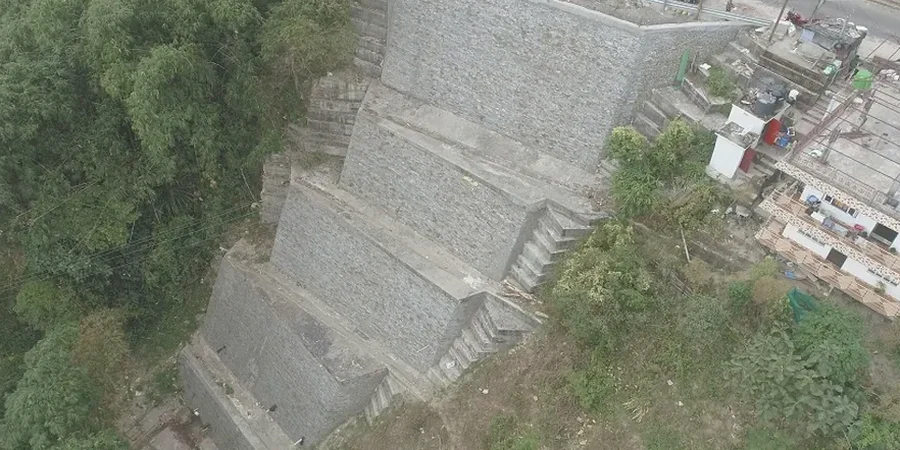
Any slope intervention in the UK must align with the framework set out in Eurocode 7 (BS EN 1997) and its UK National Annex, which governs geotechnical design. This is reinforced by BS 6031 for earthworks and BS 8006 for reinforced soil and anchorages, alongside the CDM 2015 regulations for health and safety. Blackpool Council's local planning policies also demand rigorous geotechnical reporting for any development on land steeper than 1 in 10 or within 50 metres of a cliff edge. Where slopes require active support, the design of active and passive anchors must satisfy BS 8081, covering corrosion protection, testing, and long-term monitoring. These codes are not mere paperwork; they dictate the load factors, material specifications, and design life that keep a slope safe for decades. Compliance is non-negotiable, and our documentation is structured to satisfy both building control and warranty providers like NHBC.
The projects that call for slope engineering in Blackpool span a wide spectrum. Coastal defence schemes routinely require retaining wall design that can withstand both earth pressure and wave impact, often combining sheet piles with concrete facings. Transport infrastructure, from the tramway extension to highway widening on the A583, demands stable cuttings and embankments where poor ground is improved with geogrids or soil nailing. Private clients building homes on the sloping sites of North Shore or Marton often discover that their plot requires a reinforced retaining structure to create a usable garden or driveway. Even the restoration of Blackpool's historic parks, with their Victorian-era terraces and ornamental lakes, can involve discreet slope stabilisation to preserve heritage while meeting modern safety standards. In every case, the solution must balance engineering robustness with the visual and environmental sensitivity that a seaside town demands.
FAQ
What are the first signs that a slope on my property in Blackpool might be failing?
Look for fresh tension cracks in the ground, especially parallel to the slope crest, leaning or tilting fence posts and trees, sudden changes in vegetation patterns, and doors or windows that begin to stick. Water seepage that appears where it was previously dry is a strong indicator of internal erosion. On coastal slopes, fresh exposure of bare soil or sand at the cliff face signals active retreat. Any of these signs warrants immediate professional assessment.
How do local ground conditions in Blackpool affect slope stability?
The glacial till and sandy deposits common across Blackpool can lose significant strength when saturated, making prolonged rainfall a major trigger for shallow slips. Coastal cliffs are additionally weakened by wave undercutting and salt weathering. Soft alluvium in low-lying areas can consolidate unevenly, creating long-term settlement issues. These conditions demand drainage-focused designs and often require the use of granular fill and geotextiles to manage water and reinforce the soil mass effectively.
What regulations govern slope works and retaining structures in the UK?
All slope works must comply with Eurocode 7 (BS EN 1997) for geotechnical design, supported by BS 6031 for earthworks and BS 8006 for reinforced soil. Anchor design is governed by BS 8081. The Construction (Design and Management) Regulations 2015 apply to all projects. Local planning authorities, including Blackpool Council, may impose additional requirements for development near cliffs or on steep ground, typically demanding a full geotechnical report and long-term maintenance plan.
What is the difference between active and passive anchors for slope support?
Active anchors are tensioned during installation to immediately apply a pre-determined force to the slope face, actively restraining movement. Passive anchors, such as soil nails, are not tensioned but mobilise their resistance only as the ground begins to deform. Active systems are typically used where strict control of movement is essential, such as adjacent to existing structures, while passive systems are often more economical for general slope reinforcement and are installed with less equipment.