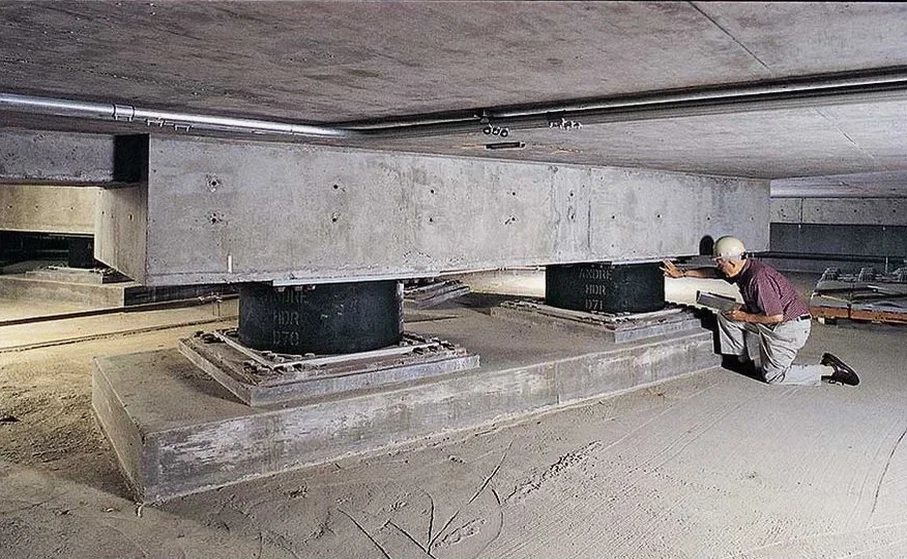
A Victorian guesthouse on the North Shore faces a fundamentally different seismic reality than a steel-framed hotel on the reclaimed sands near the Pleasure Beach. Blackpool sits atop a complex sequence of Quaternary drift deposits – glacial till overlying deep layers of soft marine alluvium and estuarine silts – where ground motions during a rare UK earthquake can amplify unpredictably. The British Geological Survey classifies much of the Fylde Coast as having a moderately soft soil profile, which directly influences spectral acceleration values used in design. Rather than relying solely on ductile detailing of the superstructure, we typically uncouple the building from ground motion entirely, integrating a seismic microzonation study at project kick-off to map the specific impedance contrast across the site, and then layering in base isolation bearings that shift the fundamental period well beyond the dominant frequency of the local soil column.
Decoupling a Blackpool structure from ground motion shifts its fundamental period from the 0.2–0.4 second range – where local soft-soil amplification peaks – to beyond 2.0 seconds, reducing seismic forces by a factor of four to six.
Our approach and scope
Local geotechnical context
During the refurbishment of a four-storey masonry structure on Topping Street, our site investigation revealed 3.5 metres of loose silty sand overlying a compressible organic layer before reaching competent till. The original structural design assumed a fixed-base condition with no allowance for differential settlement – a scenario that, under seismic shaking, would have produced concentrated shear cracking at the ground-floor columns and likely partial collapse of the unreinforced masonry infill. By introducing a rigid diaphragm slab above the isolation plane and specifying lead-rubber bearings with a 160 mm design displacement, we effectively severed the load path that transmits ground strain into brittle architectural elements. The key risk we manage on Blackpool projects is not catastrophic bearing failure – properly specified isolators are extraordinarily solid – but rather the secondary effects: pounding at the moat if the gap is undersized, rupture of rigid drainage connections that cross the isolation plane, or differential uplift at the building perimeter when overturning moments combine with soft edge soils. Each of these failure modes is preventable through rigorous peer review and construction-phase inspection.
Relevant standards
BS EN 15129:2018 – Anti-seismic devices, BS EN 1998-1:2004 + UK National Annex – Design of structures for earthquake resistance, BS EN 1337-3:2005 – Structural bearings – Elastomeric bearings, BS 5930:2015+A1:2020 – Code of practice for ground investigations, ISO 22762:2018 – Elastomeric seismic-protection isolators
Complementary services
Site-Specific Seismic Hazard Assessment
We develop uniform hazard spectra for the Blackpool site using BGS seismotectonic models and local borehole shear-wave velocity profiles. The output feeds directly into isolator displacement demand calculations per BS EN 1998-1.
Isolation System Design & Prototype Testing
Full bearing selection, nonlinear time-history analysis, and real-scale prototype verification at our UKAS-accredited laboratory, ensuring each isolator meets the required stiffness and damping properties before shipment to site.
Construction-Phase Engineering Support
We supervise isolator installation, verify moat detailing against as-built dimensions, and inspect all utility crossings across the isolation interface to prevent inadvertent rigid connections that compromise seismic performance.
Long-Term Condition Monitoring
Post-occupancy inspection programme covering bearing creep, elastomer ageing, and moat clearance. We design replaceable isolator configurations so that individual units can be swapped without demolishing the superstructure.
Typical parameters
FAQ
Is seismic isolation really necessary for a building in Blackpool, given the UK's low seismicity?
Blackpool sits on soft alluvial soils that amplify ground motion considerably. A magnitude 5 event in the Irish Sea, while rare, can produce spectral accelerations at the surface that exceed the elastic capacity of conventional masonry and concrete-frame structures. Isolation provides a cost-effective resilience strategy for essential facilities and high-value commercial projects where post-earthquake operability matters.
What is the typical cost range for a base isolation system on a Blackpool commercial building?
For a medium-scale commercial structure, the design, manufacture, and installation of a base isolation system in Blackpool generally falls between £2,880 and £6,980 per isolator, with the total project cost depending on the number of columns and the complexity of the moat detailing. A full project-specific quote requires a preliminary ground investigation and structural review.
Can base isolation be retrofitted to an existing heritage building on Blackpool's seafront?
Yes, but it demands a phased construction sequence. We typically install temporary jacking columns, cut the existing columns at the isolation plane, and insert the bearings one bay at a time. Grade II listed structures along the Promenade require close coordination with Blackpool Council's conservation officer to protect architectural fabric during the works.
How long does a base isolation installation extend the construction programme?
For new-build, the isolation layer adds approximately four to six weeks to the substructure phase, including pedestal casting, bearing installation, and moat wall construction. Retrofits are more variable and depend on the number of columns to be severed; a typical four-storey building takes eight to twelve weeks for the isolation works alone.