A contractor rings up on a Friday afternoon because the council rejected their roadbase. The reason? No in-situ density verification before the asphalt went down. It happens every month across Blackpool, from the regeneration sites near Talbot Gateway to the coastal defence works at Anchorsholme. The sand cone test remains the most direct and court-proof method for checking whether compacted fill actually meets the specification. It weighs the soil you remove against the calibrated sand that replaces it—no nuclear gauges, no assumptions about moisture. Our mobile team brings the calibrated sand, the cones, and the balances straight to the site, putting a number on compaction that the engineer can sign off without hesitation.
Relative compaction is not a guess. It is the mass of dry soil over the volume of a hole, divided by a laboratory maximum, and the sand cone gives you that volume directly.
Our approach and scope
Local geotechnical context
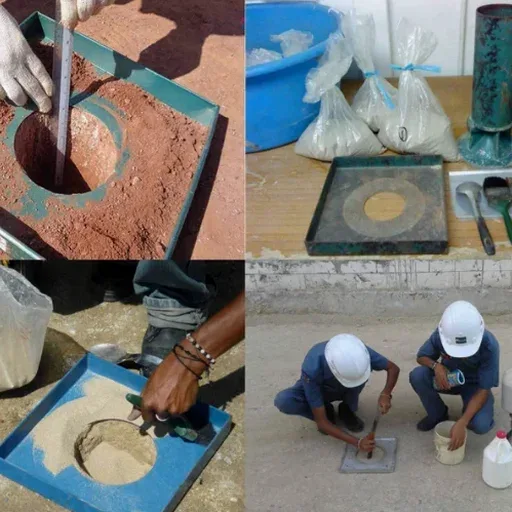
The metal base plate goes down first on the compacted surface. You dig carefully, keeping every grain of soil in a sealed bag, because losing material means you are inventing density. In Blackpool, the wind can be a real problem—it blows calibrated sand out of the cone before you get the valve open. The biggest risk is testing a material with particles larger than 37.5 mm, where the small hole volume becomes unrepresentative. We see this often on sea defence projects that use armour stone bedding. The error propagates directly into the relative compaction figure, and a false pass can lead to settlement under the promenade or cracking in a new commercial unit on the Squires Gate industrial estate. That is why our technicians reject test locations where oversize particles dominate and recommend a larger replacement method instead.
Video overview
Relevant standards
BS 1377-9:1990 – In-situ density tests (sand replacement method), Manual of Contract Documents for Highway Works – Series 600 (Earthworks), BS EN 1997-2:2007 (Eurocode 7) – Ground investigation and testing
Complementary services
Field Density by Sand Cone (BS 1377-9)
On-site density determination using calibrated silica sand. Suitable for fine- and medium-grained soils with a maximum particle size of 37.5 mm. We provide the relative compaction result within hours.
Laboratory Compaction (Proctor) Testing
Determines the maximum dry density and optimum moisture content of the fill material. This reference value is essential for calculating relative compaction from the sand cone result.
Plate Load and CBR Verification
When the specification also requires stiffness or bearing capacity, we combine density testing with plate load tests (static modulus) or CBR tests on the compacted formation.
Typical parameters
FAQ
How much does a sand cone density test cost in Blackpool?
A single sand cone test in the Blackpool area typically costs between £80 and £120, depending on the number of tests requested on the same visit. The price includes the calibrated sand, the field work by a qualified technician, and the formal report. Volume discounts apply when five or more tests are booked together, which is common on highway projects.
How quickly can you get to a site in Blackpool?
We can usually have a technician on site within 24 to 48 hours of your call, and same-day mobilisation is often possible for urgent situations. Our laboratory vehicle is based centrally, so Blackpool, Fleetwood, Lytham, and Kirkham are all within a short drive. Just call before 9 am and we will do our best to get the calibrated sand and the balances out to you the same morning.
What is the difference between a sand cone test and a nuclear density gauge?
The sand cone method directly measures the volume of the excavated hole by replacing the soil with sand of a known density, giving a primary measurement of mass and volume. A nuclear gauge infers density from the backscatter or transmission of gamma radiation and requires a site-specific calibration against a sand cone or block standard. For contentious results in Blackpool's variable glacial till, the sand cone is the reference method accepted in arbitration.
What soil types can you test with the sand cone method?
The method works best on soils with a maximum particle size of 37.5 mm. It is ideal for the sands, silts, and clays common along the Fylde Coast. If the material contains cobbles or large fragments—such as the armour stone used in sea defences—we recommend switching to a water replacement or large-scale replacement method to get a representative volume.
Do you provide the relative compaction calculation on site?
Yes. We carry the laboratory Proctor curve for the project material with us. As soon as the field density is calculated, we divide it by the maximum dry density and give the engineer the relative compaction percentage before we leave. The formal report with the test location plan, raw data, and compliance statement follows within 24 hours. More info.