Blackpool sits barely 5 metres above sea level on a coastal plain of glacial till, blown sand, and deep alluvial silts. That ground profile makes conventional shallow foundations risky across much of the Fylde coast. We design vibro stone columns that transfer structural loads through the soft upper strata to competent bearing layers below. Every scheme we deliver follows BS EN 1997-1:2004 and the ICE Specification for Ground Treatment, backed by in-situ testing data from CPT testing and test pits that map the exact stratigraphy before a single rig moves on site. For Blackpool projects where liquefaction potential exists in the loose sand lenses, we work with liquefaction assessment to verify post-treatment densification targets.
A well-designed stone column grid turns Blackpool's soft alluvial profile into a composite ground mass that settles uniformly under load.
Our approach and scope
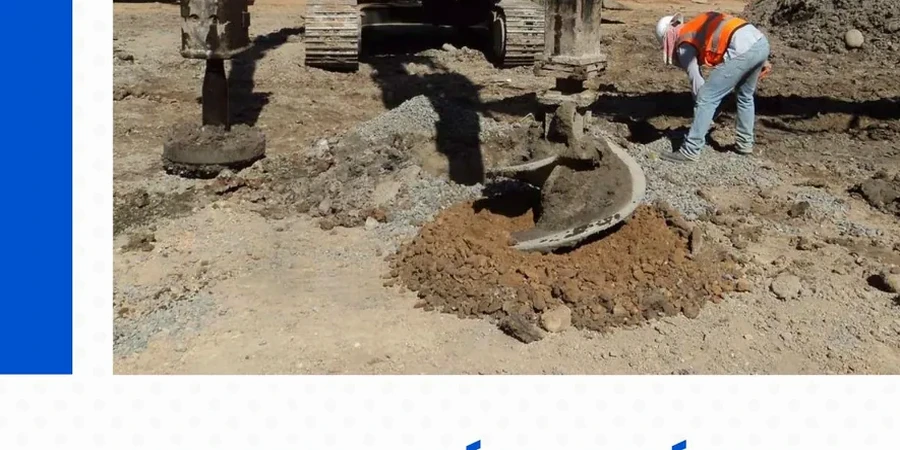
Local geotechnical context
Blackpool's exposure to westerly storms and a water table that sits within 1.5 metres of ground surface for much of the year creates a working environment where groundwater control is non-negotiable. A stone column installation that ignores pore pressure dissipation can trigger quick condition failures in the fine sands common along the Promenade and Squires Gate areas. We specify pre-drilling through stiff crust layers, maintain positive head during column formation, and verify densification with post-installation CPT or zone load tests. The tidal influence on groundwater levels means our designs account for fluctuating buoyancy forces that affect both short-term installation stability and long-term settlement performance. Without this local hydrogeological calibration, even a well-spaced column grid can underperform within two winter cycles.
Relevant standards
BS EN 1997-1:2004 (Eurocode 7 — Geotechnical design), ICE Specification for Ground Treatment (2nd edition), BS 5930:2015+A1:2020 (Code of practice for ground investigations), BRE Digest 433 — Vibro stone columns
Complementary services
Vibro stone column design package
Full design to Eurocode 7 including bearing capacity, settlement analysis, liquefaction mitigation check, and installation specification with column grid, depth criteria, and acceptance testing schedule.
Post-installation verification
CPT before and after treatment, zone load testing to BRE Digest 433, and settlement monitoring to confirm design assumptions and sign off the improved ground for foundation construction.
Typical parameters
FAQ
How much does stone column design cost for a typical Blackpool project?
Design fees for a stone column scheme in Blackpool generally fall between £1,260 and £3,840, depending on site area, number of columns, ground investigation data already available, and the level of verification testing required. A small residential plot with existing borehole logs sits at the lower end; a commercial site needing full CPT grid design and zone load test specification sits at the upper end.
What ground conditions in Blackpool make stone columns necessary?
Much of Blackpool is underlain by soft alluvial silts, loose blown sands, and pockets of peat — particularly in the low-lying areas between the Promenade and the M55 corridor. These soils compress under load and can liquefy. Stone columns densify the surrounding ground and provide stiff drainage paths, making the composite soil mass suitable for conventional foundations.
How do you verify that the stone columns are working correctly?
We use a combination of pre- and post-installation CPT soundings to measure the increase in cone resistance, zone load tests on groups of columns to confirm settlement behaviour, and in some cases plate load tests on individual columns. All results are compared against the design settlement criteria specified in the ICE Ground Treatment specification.
What's the difference between stone columns and vibrocompaction?
Vibrocompaction densifies clean granular soils by vibration alone, without adding stone. Stone columns — or vibro replacement — involve inserting stone into the ground to form stiff columns that reinforce fine-grained soils like silts and soft clays. In Blackpool, where mixed alluvial profiles are common, we often use stone columns because the silty layers do not densify effectively by vibration alone.
How long does a stone column installation take in Blackpool?
A typical residential or light commercial project with 30 to 80 columns takes 3 to 7 working days on site, plus a further week for post-installation testing and reporting. Larger schemes run longer. Weather and tidal groundwater fluctuations can affect the programme, particularly during winter months.