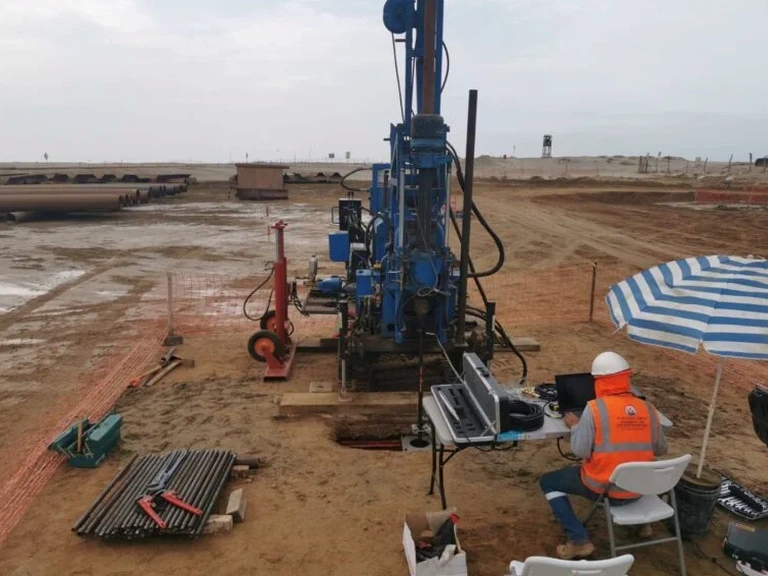
The 20-tonne CPT rig rolls onto your Blackpool site with a 15 cm² electric cone, a seismic module, and a hydraulic ram that pushes at a constant 2 cm per second. We don’t guess at bearing capacity—we measure it. Blackpool’s geology shifts from wind-blown sand at Squires Gate to soft alluvial clay near Marton Mere, and a standard SPT hammer can smear those transitions. Our piezocone captures pore pressure on the push, so you know exactly where the water table sits and how fast the clay will consolidate. When we pair the CPT with grain size analysis from a nearby borehole, you get a continuous strength profile backed by direct classification. That combination saves at least one extra investigation day on a typical hotel extension project along the Promenade.
A CPT rig delivers 200 data points per metre. No recovery issues, no disturbance—just a continuous log of what the ground actually does under load.
Our approach and scope
Local geotechnical context
The Fylde Peninsula is underlain by thick Quaternary sequences: Sherwood Sandstone bedrock sits 30–70 m below loose to medium-dense blown sand and soft estuarine clay. Blackpool’s seaward boundary means groundwater is high—often within 1.5 m of the surface—and pore pressure dissipation tests during CPT soundings are the only reliable way to measure the coefficient of consolidation in those silty clays. A skipped dissipation test leaves you guessing how much settlement will occur over the first three years of a building’s life. The consequence shows up later: differential movement cracking facades on a seafront apartment block. We run at least two dissipation tests per distinct clay layer and report the t50 value directly, because Blackpool’s soft clays consolidate slowly and every millimetre of predicted settlement matters when you’re insuring a structure against coastal ground movement.
Relevant standards
BS EN ISO 22476-1:2012 (CPT and CPTU), BS EN 1997-2 (Eurocode 7: Ground investigation), BS 5930:2015+A1:2020 (Code of practice for ground investigations), BS EN 1998-5 (Eurocode 8: Foundations, retaining structures)
Complementary services
Piezocone (CPTU) with Dissipation Testing
Full electric cone penetration test with pore pressure measurement at the u2 shoulder. We run dissipation holds in cohesive layers to determine the coefficient of consolidation and estimate long-term settlement. Output: SBTn classification, undrained shear strength profile, and t50 consolidation values.
Seismic CPT (SCPT)
CPT rig fitted with a seismic cone and geophone to measure shear wave velocity every metre. We correlate Vs directly with cone resistance for microzonation and site class determination per BS EN 1998-1. Ideal for Blackpool sites where a separate MASW survey would require additional traffic management.
Typical parameters
FAQ
How long does a CPT take on a typical Blackpool residential plot?
A single 20 m CPT push on a standard terrace plot takes about 45 minutes of penetration time. With rig setup, utility clearance, and demobilisation, plan for a 2-hour site visit. We complete three to four locations in a single day on larger commercial sites like those around the Enterprise Zone.
What does CPT testing cost in Blackpool?
A standard CPT sounding to 20 m depth in the Blackpool area runs between £130 and £200 per location, depending on access constraints and whether pore pressure dissipation tests are required. Mob-demob within the FY postcode is included. Seismic CPT adds approximately £60 per location for the geophone and additional processing time.
Can CPT replace boreholes for foundation design?
In Blackpool’s sands and soft clays, a CPT profile often provides better continuous strength data than a borehole with SPTs at 1.5 m intervals. However, you still need at least one borehole to recover samples for index testing—Atterberg limits, particle size distribution, and chemical testing for aggressive ground conditions. We always recommend pairing CPT soundings with a single targeted borehole rather than relying on CPT alone.