The Fylde Coast presents a distinct challenge for earthworks: beneath Blackpool's promenades and residential streets lies a blanket of Quaternary wind-blown sand over boulder clay, with groundwater often perched just a couple of metres down. The sand is uniform, fine, and notoriously difficult to compact without precise moisture control. We have seen countless projects across Blackpool where a well-executed Proctor test has saved thousands of pounds in re-work, simply by identifying the correct target density before the first roller hits the formation. Whether it is a housing development in Bispham or a commercial pad near the airport, establishing the maximum dry density and optimum moisture content for the local material is the single most cost-effective step in any compaction specification. Alongside the sand cone density test for in-situ verification, the laboratory Proctor curve provides the benchmark that Blackpool's sandy soils demand.
On Blackpool's wind-blown sands, a 2% swing in moisture content can drop the achieved density by over 10% — the Proctor curve is not a formality, it is the contractor's only reliable target.
Our approach and scope
Local geotechnical context
A contractor working on a new retail unit off Squires Gate Lane placed 600 mm of engineered fill under what they believed was a compliant method specification. The sand was compacted in 200 mm lifts using a 2.5-tonne tandem roller, but no Proctor reference had been established beforehand. Post-construction sand replacement tests showed densities hovering around 88-92% of the maximum dry density we later determined in the laboratory. The consequence was a floor slab that began to settle within six months, cracking partition walls and requiring costly resin injection. The root cause was simple: the sand's natural moisture content on the day of placement was 6%, whereas the optimum moisture content from the Modified Proctor curve was 10.2%. Without a Proctor test to guide the contractor, the moisture condition was never adjusted, and the air-voids volume remained unacceptably high. In Blackpool's coastal environment, where seasonal groundwater fluctuation is pronounced, that kind of oversight turns a minor specification gap into a structural defect.
Video overview
Relevant standards
BS 1377-4:1990 — Methods of test for soils for civil engineering purposes: Compaction-related tests, BS EN 1997-2:2007 (Eurocode 7) — Ground investigation and testing, Manual of Contract Documents for Highway Works (SHW), Series 600 — Earthworks, BS 5930:2015+A1:2020 — Code of practice for ground investigations
Complementary services
Standard Proctor (BS Light)
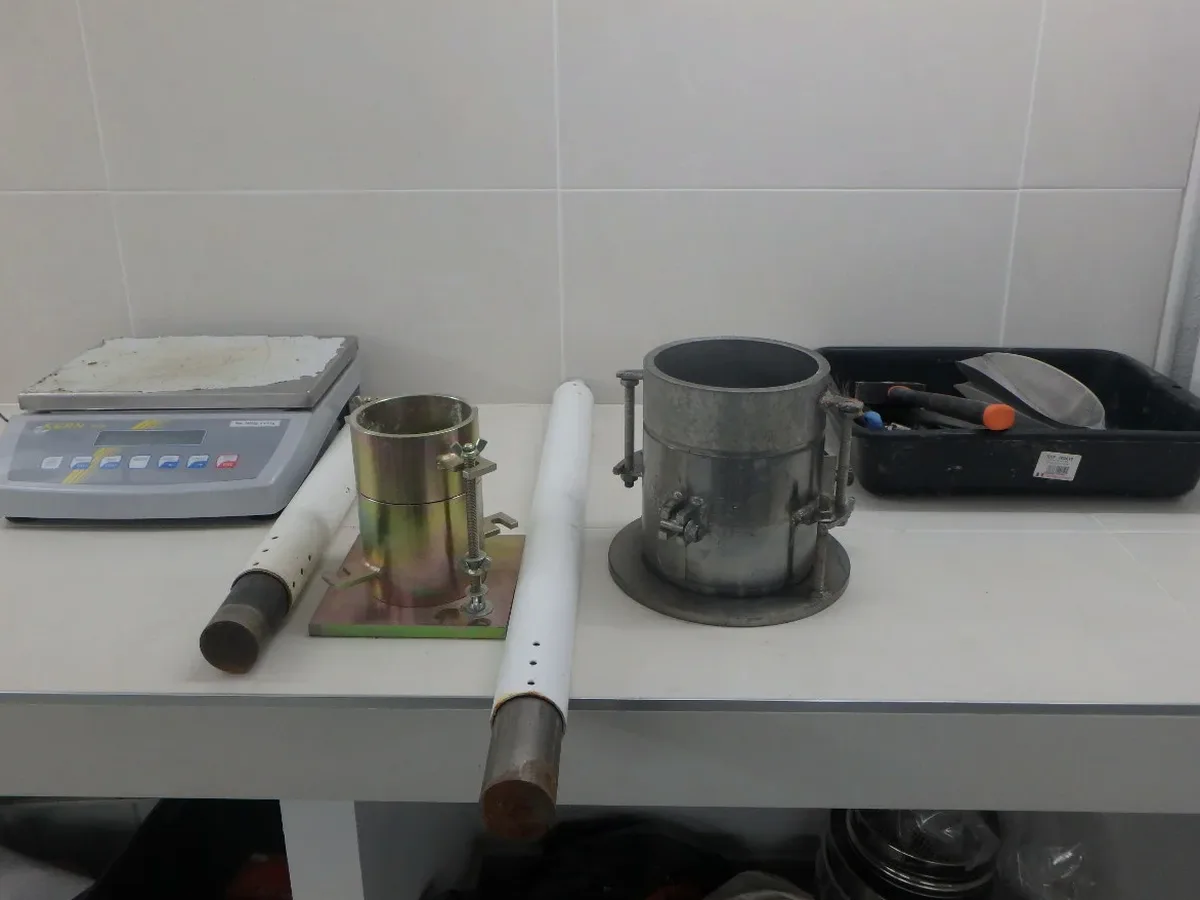
The 2.5 kg rammer method suitable for fine-grained soils, general fill and subgrade beneath lightly trafficked pavements. We test material sampled from across Blackpool, including the silty sands of the Fylde plain, and provide the full curve plus 95% and 98% target densities.
Modified Proctor (BS Heavy)
The 4.5 kg rammer method specified for road sub-base, heavily loaded industrial slabs and airport pavements. Essential for Blackpool's sand-dominated sites where Standard effort underestimates achievable density. We report air-voids content at each moisture increment to validate the degree of saturation.
In-Situ Density Correlation
Combining the Proctor benchmark with sand replacement, nuclear gauge or core cutter testing on site. We help Blackpool site teams set realistic compaction targets, adjust rolling patterns and confirm compliance before the resident engineer signs off the formation level.
Typical parameters
FAQ
What is the cost of a Proctor test in Blackpool?
For a single-point Standard or Modified Proctor determination on one bulk sample, prices typically fall between £90 and £180, depending on the number of moisture points required and whether an oversize correction is needed. We provide a firm quote once we know the material type and specification being used.
When should I specify a Modified Proctor instead of Standard?
Modified Proctor is specified when the earthworks will carry heavy or dynamic loading — road sub-base, car parks, industrial hardstandings, or airport pavements. On Blackpool's clean sands the Modified effort also produces a more realistic target density because the Standard effort rarely closes the air-voids sufficiently. Check your SHW Series 600 clause or the project-specific earthworks specification.
How much material do you need for a Proctor test?
We need roughly 25-30 kg of representative bulk sample for a 1-litre mould test, or 50-60 kg if the material contains gravel and requires the 2.3-litre CBR mould. The sample should be bagged immediately after excavation to prevent moisture loss, and delivered to our laboratory within 48 hours.
Can you test material that already contains cement or lime?
Yes, but time is critical. Cement-modified or lime-stabilised materials begin to hydrate the moment water is added, so the compaction must be completed within the specified mellowing period. We schedule treated-soil Proctor tests with priority turnaround and can also determine the moisture-conditioning value (MCV) if required for acceptability criteria.
What if my fill material has stones larger than 37.5 mm?
BS 1377-4 provides an oversize correction procedure when the fraction retained on the 37.5 mm sieve exceeds 5% of the total mass. We measure the bulk density and water absorption of the coarse fraction and apply a mathematical correction to the Proctor curve. For materials with very high cobble content, we may recommend a large-scale compaction test using a 300 mm mould, though this is less common on Blackpool's predominantly sandy sites.