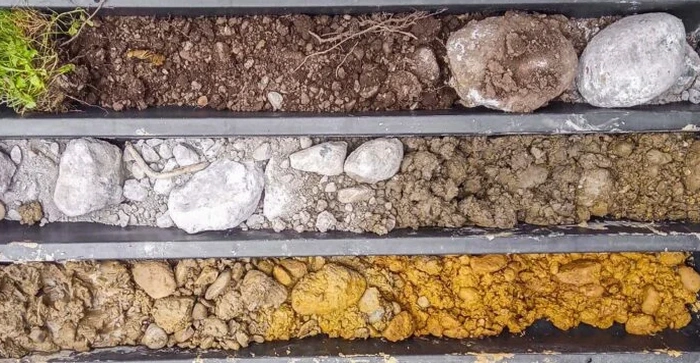
A three-storey hotel extension near Talbot Road hit unexpected organic silt at 1.8 m last autumn, forcing a last-minute foundation redesign. That scenario repeats across Blackpool more often than it should, because the superficial geology here is deceptive: windblown sand over glacial till, with pockets of alluvium and historic fill along the old stream courses. An exploratory test pit programme strips away that uncertainty in a single shift. We excavate to a typical depth of 3.0–4.5 m, log strata to BS 5930:2015, photograph the face, and recover disturbed and undisturbed samples for laboratory index testing. When the logs show clean medium-dense sand, a conventional strip footing works. When they reveal soft clay or buried topsoil under made ground, the structural engineer has hard evidence to switch to a raft or piled solution before the tender goes out. For deeper profiles we pair test pits with SPT drilling to carry the investigation to 10 m or beyond, giving you a continuous ground model from pavement level down to competent bearing strata.
A well-located test pit tells you more about Blackpool's ground in two hours than a desktop study reveals in two weeks.
Our approach and scope
For road and car-park construction the CBR profile of the subgrade often governs pavement thickness; we extract bulk samples from each stratum and run laboratory CBR testing to feed the AASHTO or UK DMRB design method. In silty sands near the seafront we sometimes add a sand cone density test to verify compaction of imported fill beneath floor slabs, closing the loop between investigation and construction quality control.
Local geotechnical context
BS EN 1997-1:2004 (Eurocode 7) requires that the ground investigation be sufficient to establish the ground model and geotechnical design parameters for the limit states being checked. In Blackpool the shallow risk profile is dominated by three factors: the unpredictable thickness of made ground along the seafront and older residential streets, the potential for perched water within sand lenses after heavy rain, and the presence of soft alluvial clays in buried channels that once drained toward the Irish Sea. A desk study alone cannot rule out any of these; only physical inspection of the soil profile does. Skipping the test pit stage means the designer assumes a homogeneous ground that almost never exists here, and that assumption can translate into excessive settlement, water ingress into services, or sulphate attack on buried concrete where industrial fill is present. Our logs include pH and water-soluble sulphate screening on request, giving the structural designer the chemical exposure class for concrete specification.
Relevant standards
BS 5930:2015 – Code of practice for ground investigations, BS EN 1997-1:2004 – Eurocode 7: Geotechnical design – General rules, BS EN 1997-2:2007 – Eurocode 7: Ground investigation and testing, BRE Special Digest 1 – Concrete in aggressive ground (for sulphate/ pH assessment)
Complementary services
Standard Trial Pit Package
Machine-excavated pit to 3.5 m depth, logged to BS 5930 by a qualified geotechnical engineer, with bulk and U100 sampling, groundwater observation, GPS location, and a digital log with colour photographs. Suited to residential extensions, small commercial units, and retaining wall feasibility studies.
Investigation-to-Design Package
Multiple pits across the site plus targeted laboratory testing: Atterberg limits, particle size distribution, moisture content, and pH/sulphate suite. We deliver a factual report and a short interpretive note with bearing capacity estimates and foundation recommendations referenced to Eurocode 7. Ideal for new-build housing schemes and school extensions where building control requires a declared ground model.
Typical parameters
FAQ
How much does an exploratory test pit cost in Blackpool?
For a single machine-dug trial pit with a standard log, sampling, and a digital report, budget between £350 and £610 depending on depth, access constraints, and the number of samples sent to the laboratory. Sites requiring traffic management on a main road or pedestrian exclusion zones near the promenade fall toward the upper end of the range.
What depth can you reach with a test pit in sandy ground?
In Blackpool's Shirdley Hill Sand we routinely reach 3.5 to 4.0 m with a 1.8 m wide bucket before stepping the pit or installing trench support. Beyond 4.5 m safety regulations make it more practical to switch to a window sampler or cable-percussive borehole. We assess the safe working depth on the day based on soil stand-up time and groundwater conditions.
Do you backfill the pit after logging, and what material do you use?
Yes, we backfill the same day unless 24-hour groundwater monitoring has been requested. The pit is reinstated in compacted layers using the arisings where they are suitable, or imported granular fill if the original material is contaminated or too wet to compact. We aim to leave the surface level, safe, and ready for the next trade.
Can you take samples for contamination testing from a trial pit?
Absolutely. We can collect soil samples in glass jars or laboratory-supplied containers for a standard UKAS-accredited suite: heavy metals, TPH, PAH, asbestos screen, and WAC testing if off-site disposal is planned. Our logs note any visual or olfactory signs of contamination and we can schedule a visit to coincide with your environmental consultant's sampling protocol.